この記事では、Progress Monitoringツールから抽出したCIPMレポートを次のものに変換できるPythonスクリプトの作成方法について説明します:
- Revitモデルやその他のツールで使用するBCFファイル
- Coverageパラメータに基づいて、問題のあるモデル要素に関連付けられた、Cintooプロジェクト内の書式設定済みの注釈
権限:役割に注釈の管理権限が含まれるユーザーは、このスクリプトを使用して注釈を作成できます。
添付ファイルにスクリプトの例を用意しています。補助スクリプトもすべて添付されています。
目次
前提条件
お好みのAIチャットボットの案内に従って、Pythonをインストールします。専用の環境がインストールされていない場合は、コマンドプロンプトからPythonスクリプトを実行する手順をAIチャットボットに尋ねてください。
このPythonスクリプトでは、ワークフローを実行するために次のライブラリが使用されます。
スクリプトを使用する前に、これらをインストールします:
- png - ライブラリを接続するには、次のコマンドを実行します
pip install pypng- requests - ライブラリを接続するには、次のコマンドを実行します
pip install requests入力情報
コマンドプロンプトでスクリプトcreateBCF.pyを実行します。その他のスクリプトはすべて補助スクリプトです。
python createBCF.py
実行すると、スクリプトは次の情報の入力を求めます。
- Insert the path to the CIPM .csv report - 拡張子を含む、CSV形式のCIPMレポートへのフルパス
例:C:\Projects\ProgressMonitoring\Walls_0.0500(Meters).csv - Insert the path where BCF files should be created - BCFファイルをローカルに作成して保存するフォルダーのフルパス
例:C:\Projects\ProgressMonitoring\BCF - Insert the minimum coverage - ユーザー定義のしきい値(パーセント)。これを厳密に下回るすべてのCoverage値が対象になります。
例:スキャンカバレッジが25%未満のモデル要素に対してBCF/注釈を作成するには、値25を入力します - Insert the path to the workzone where to create annotations - Cintooプロジェクト内のワークゾーンの完全なURLアドレス。
注:このスクリプトで作成される注釈専用のワークゾーンを作成することを強くお勧めします。結果をより細かく管理でき、必要な場合に簡単にクリーンアップできます。
例:https://aec.cintoo.com/accounts/0a000a00-000a-000a-a0000aa0a00000a0/
projects/a0a0000a-aaa0000a-000a-aaaa00aaa000/workzones/aaaaaaaaaa0aaaaaaaa/data
このURLはブラウザーから直接コピーします。
認可
すべてのパラメータを入力すると、ポップアップ表示されたブラウザーページで、Cintooアカウントの使用を認可するよう求められます。Allowをクリックして続行します。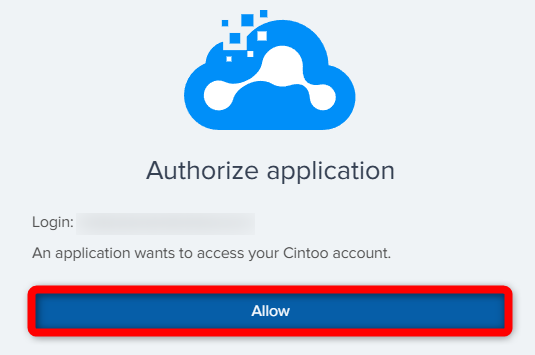
認可が完了すると、認証が正常に完了したことを示す次のメッセージが表示されます。このブラウザータブは、安全に閉じることができます。

Cintoo-tokens.json - 接続を確立するためにスクリプトによって作成される認証用のJSONファイルです。作業が終了するたびに削除することをお勧めします。
注:BCFと注釈の生成にかかる時間は、カバレッジレベルの値とモデル要素の数によって異なります。
制限事項
警告:APIを使用するこのスクリプトで作成できる注釈は最大3000件であることにご注意ください。
結果
- ユーザー定義のパスにローカル保存されたBCFファイル。たとえばRevitで使用して、問題のあるモデル要素を検出し、修正できます

- プロジェクト内にあるCintooの注釈 。モデル要素に視覚的に関連付けられ、必要なデータがすべて説明に含まれています(編集可能)。

CreateBCF.pyスクリプトの解説
以下に、各部分にコメントを付けたスクリプトを示します。
警告:コードに調整が必要な場合は変更することも可能ですが、変更後のコードの機能について、Cintooは一切責任を負いません。
import csv
import os
import zipfile
import png
from createAnnotation import createAnnotation
import login
from cintooUtils import parse_cintoo_workzone_context_url
import datetime
import uuid


def create_png(path):
    width = 255
    height = 255
    img = []
    for y in range(height):
        row = ()
        for x in range(width):
            row = row + (x, max(0, 255 - x - y), y)
        img.append(row)
    with open(path, 'wb') as f:
        w = png.Writer(width, height, greyscale=False)
        w.write(f, img)
必要なすべてのライブラリと補助スクリプトをインポートして、メインスクリプトをサポートします。BCFファイルの作成に必要なテンプレートのpngを作成します。
def create_bcfzip(input_csv,
                  output_dir,
                  min_coverage,
                  tenant=None,
                  account_id=None,
                  project_id=None,
                  workzone_id=None,
                  camera_state=None,
                  headers=None):
    if not os.path.exists(output_dir):
        os.makedirs(output_dir)
    report_name = input_csv.split("\\")[-1]

    with open(input_csv, 'r', encoding='utf-8') as file:
        reader = csv.DictReader(file)
        elements_to_be_created = [row for row in reader if float(row['Coverage by Scan Data (%)']) < min_coverage]
        if len(elements_to_be_created) > 1000:
            print("More than 1000 elements have a lower score than the minimum coverage score. Only the top 1000 will be created.")
            elements_to_be_created = sorted(
                elements_to_be_created,
                key=lambda x: float(x['Coverage by Scan Data (%)']),
                reverse=True
            )[0:999]
        for row in elements_to_be_created:
            if (row.get('IfcGUID') or row.get('GlobalId')) and row.get('Coverage by Scan Data (%)'):
                print(row)
                try:
                    coverage = float(row['Coverage by Scan Data (%)'])
                    print(coverage)
                except ValueError:
                    continue
                guid = row.get('IfcGUID') or row.get('GlobalId')
                element_name = row.get('Model Element Name', 'Unknown')
                element_id = list(row.values())[0]
                print(element_id)
                create_bcf_file(guid, element_name, output_dir, coverage, report_name)
                if all([tenant, account_id, project_id, workzone_id, camera_state]):
                    createAnnotation(tenant,
                                     account_id,
                                     project_id,
                                     workzone_id,
                                     f'Low Coverage Issue: {element_name}',
                                     f"The element {element_name} has a coverage score of {coverage}, according to the report {report_name}",
                                     {"x": 0, "y": 0, "z": 0},
                                     camera_state,
                                     headers,
modelElementId=element_id)ユーザーが定義したCoverageパラメータに基づいて取得した各要素に関連するBCFファイルを作成する関数。
出力ディレクトリ、最小カバレッジ、Tenantなどのユーザー指定パラメータと、CIPMレポートの各行に含まれる既存のGUIDを解析し、カバレッジの比較に基づいてそれらを抽出します。
警告:create_bcfzip関数は変更しないことをお勧めします。データを選択する条件の動作(たとえば、coverage<min_coverage)を変更する必要がある場合にのみ変更してください。注釈のテキスト、説明、ラベルを変更する場合は、create_issue_xml関数を参照してください。
def create_bcf_file(guid, element_name, output_dir, coverage, report_name):
    bcf_dir = os.path.join(output_dir, guid)
    os.makedirs(bcf_dir, exist_ok=True)
    viewpoint_guid = str(uuid.uuid4())
    comment_guid = str(uuid.uuid4())
    topic_guid = str(uuid.uuid4())
    project_guid = str(uuid.uuid4())

    viewpoint_filename = os.path.join(bcf_dir, 'viewpoint.bcfv')
    viewpoint_xml = create_viewpoint_xml(guid, viewpoint_guid)
    with open(viewpoint_filename, 'w', encoding='utf-8') as f:
        f.write(viewpoint_xml)

    issue_filename = os.path.join(bcf_dir, 'markup.bcf')
    issue_xml = create_issue_xml(element_name, coverage, report_name, viewpoint_guid, comment_guid, topic_guid)
    with open(issue_filename, 'w', encoding='utf-8') as f:
        f.write(issue_xml)

    project_filename = os.path.join(output_dir, 'project.bcfp')
    project_xml = create_project_xml(project_guid)
    with open(project_filename, 'w', encoding='utf-8') as f:
        f.write(project_xml)

    version_filename = os.path.join(output_dir, 'bcf.version')
    with open(version_filename, 'w', encoding='utf-8') as f:
        f.write(create_bcf_version())
    snapshot_filename = os.path.join(output_dir, 'snapshot.png')
    create_png(snapshot_filename)

    zip_filename = os.path.join(output_dir, f'{guid}.bcf')
    with zipfile.ZipFile(zip_filename, 'w') as zf:
        zf.write(viewpoint_filename, os.path.join(topic_guid, 'viewpoint.bcfv'))
        zf.write(issue_filename, os.path.join(topic_guid, 'markup.bcf'))
        zf.write(snapshot_filename, os.path.join(topic_guid, 'snapshot.png'))
        zf.write(project_filename, os.path.join('project.bcfp'))
        zf.write(version_filename, os.path.join('bcf.version'))

    # クリーンアップ
    os.remove(viewpoint_filename)
    os.remove(issue_filename)
    os.remove(project_filename)
    os.remove(version_filename)
    os.remove(snapshot_filename)
    os.rmdir(bcf_dir)
個別のBCFファイルを作成します。
def create_viewpoint_xml(guid, viewpoint_guid):
    return f"""<?xml version="1.0" encoding="UTF-8"?>
<VisualizationInfo Guid="{viewpoint_guid}">
	<Components>
		<ViewSetupHints SpacesVisible="false" SpaceBoundariesVisible="false" OpeningsVisible="false" />
		<Selection>
			<Component IfcGuid="{guid}" />
		</Selection>
		<Visibility DefaultVisibility="true" />
	</Components>
	<OrthogonalCamera>
		<CameraViewPoint>
			<X>129.93820633961636</X>
			<Y>-124.61204504554462</Y>
			<Z>104.47418360973809</Z>
		</CameraViewPoint>
		<CameraDirection>
			<X>-0.58963662529065941</X>
			<Y>0.5647967039409042</Y>
			<Z>-0.57735026918962584</Z>
		</CameraDirection>
		<CameraUpVector>
			<X>-0.41693605617897656</X>
			<Y>0.39937157934842415</Y>
			<Z>0.81649658092772603</Z>
		</CameraUpVector>
		<ViewToWorldScale>44.256083397559856</ViewToWorldScale>
	</OrthogonalCamera>
</VisualizationInfo>"""
デフォルトのカメラ位置を設定します。
def create_issue_xml(element_name, coverage, report_name, viewpoint_guid, comment_guid, topic_guid):
    return f"""<?xml version="1.0" encoding="UTF-8"?>
<Markup>
	<Topic Guid="{topic_guid}" TopicType="Issue" TopicStatus="Active">
		<Title>Low Coverage Issue: {element_name}</Title>
		<Priority>Normal</Priority>
		<Index>1</Index>
		<CreationDate>2025-03-05T09:22:02+00:00</CreationDate>
		<CreationAuthor>youremail@domain.com</CreationAuthor>
		<ModifiedDate>2025-03-05T09:22:03+00:00</ModifiedDate>
		<ModifiedAuthor>youremail@domain.com</ModifiedAuthor>
		<DueDate>2025-03-05T09:00:00+00:00</DueDate>
		<AssignedTo>youremail@domain.com</AssignedTo>
		<Description>The element {element_name} has a coverage score of {coverage}, according to the report {report_name}</Description>
	</Topic>
	<Comment Guid="{comment_guid}">
		<Date>2025-03-04T09:53:03+00:00</Date>
		<Author>youremail@domain.com</Author>
		<Comment>The element {element_name} has a coverage score of {coverage}, according to the report {report_name}</Comment>
		<Viewpoint Guid="{viewpoint_guid}" />
		<ModifiedDate>2025-03-04T09:53:03+00:00</ModifiedDate>
		<ModifiedAuthor>youremail@domain.com</ModifiedAuthor>
	</Comment>
	<Viewpoints Guid="{viewpoint_guid}">
		<Viewpoint>viewpoint.bcfv</Viewpoint>
		<Snapshot>snapshot.png</Snapshot>
	</Viewpoints>
</Markup>
    """
問題のメタデータ用のXMLを作成します。
次のフィールドに、作成者に関する必要な情報を入力します。
- CreationAuthor - 154行目
- ModifiedAuthor - 156行目
- AssignedTo - 158行目
- Author - 163行目
- ModifiedAuthor - 167行目
def create_project_xml(projectGuid):
    return f"""<?xml version="1.0" encoding="UTF-8"?>
<ProjectExtension>
	<Project ProjectId="{projectGuid}" />
	<ExtensionSchema></ExtensionSchema>
</ProjectExtension>"""
プロジェクトを参照するファイルを作成します。
def create_extensions_xsd():
    return """<?xml version="1.0" encoding="UTF-8" standalone="no" ?>
    <schema>
        <redefine schemaLocation="markup.xsd">
            <simpleType name="Priority">
                <restriction base="Priority">
                    <enumeration value="Aucune"/>
                    <enumeration value="Faible"/>
                    <enumeration value="Moyenne"/>
                    <enumeration value="Haute"/>
                    <enumeration value="Critique"/>
                </restriction>
            </simpleType>
            <simpleType name="TopicStatus">
                <restriction base="TopicStatus">
                    <enumeration value="Assignée"/>
                    <enumeration value="En cours"/>
                    <enumeration value="Terminée"/>
                    <enumeration value="Bloquée"/>
                    <enumeration value="Validée"/>
                    <enumeration value="Archivée"/>
                </restriction>
            </simpleType>
            <simpleType name="TopicLabel">
                <restriction base="TopicLabel"/>
            </simpleType>
        </redefine>
    </schema>
    """
BCFの構造(カテゴリ)を記述します。
def create_bcf_version():
    return """<?xml version="1.0" encoding="UTF-8"?>
<Version VersionId="2.1" xsi:noNamespaceSchemaLocation="version.xsd" xmlns:xsi="http://www.w3.org/2001/XMLSchema-instance">
	<DetailedVersion>2.1 KUBUS BV</DetailedVersion>
</Version>"""
BCFのバージョン(2.1)を定義します。
def main():
    input_csv = input("Insert the path to the CIPM .csv report :")
    output_dir = input("Insert the path where BCF files should be created :")
    min_coverage = float(input("Insert the minimum coverage"))
    context_url = input("Insert the path to the workzone where to create annotations (e.g: "
                        "https://aec.cintoo.com/accounts/0a000a00-000a-000a-a000-0aa0a00000a0/projects/a0a0000a-aaa0"
                        "-000a-000a-aaaa00aaa000/workzones/aaaaaaaaaa0aaaaaaaa/data ")
    context_details = parse_cintoo_workzone_context_url(context_url)
    tenant, account_id, project_id, workzone_id = context_details['tenant'], context_details['accountId'], \
        context_details['projectId'], context_details['workzoneId']

    # 認証してアクセストークンを取得
    login.load_tokens()
    token = login.get_token(tenant)
    headers = {"Authorization": f"Bearer {token}"}

    camera_state = {"type": "legacy",
                    "camerastate": {
                        "position": [0, 0, 1],
                        "rotationQuaternion": [0, 0, 0, 1],
                        "fov": 1.5708,
                        "ortho": False,
                        "overviewScale": 10,
                        "camType": "scan"},
                    }

    create_bcfzip(input_csv,
                  output_dir,
                  min_coverage,
                  tenant,
                  account_id,
                  project_id,
                  workzone_id,
                  camera_state,
                  headers)


main()ユーザーに入力を求める質問、アクセストークンの取得、Cintoo API認証に従ったCintooアカウントでの認証、Cintooにインポートすると変更されるデフォルトのカメラ位置、出力BCFzipファイルの作成、およびメイン関数の実行を行う、スクリプトのメイン部分の定義。
CreateAnnotation.pyスクリプトの解説
以下に、各部分にコメントを付けたスクリプトを示します。
警告:コードに調整が必要な場合は変更することも可能ですが、変更後のコードの機能について、Cintooは一切責任を負いません。
import login
import requests
from cintooUtils import parse_cintoo_workzone_context_url

TIMEOUT = 10
必要なすべてのライブラリと補助スクリプトのデータをインポートして、メインスクリプトをサポートします。タイムアウトパラメータを設定します。
def getWorkzoneGuid(tenant, account_id, project_id, workzone_idv1, headers):
    url = f"{tenant}/api/2/accounts/{account_id}/projects/{project_id}/workzones"

    response = requests.get(url, headers=headers, timeout=TIMEOUT)
    response.raise_for_status()
    return [wz for wz in response.json() if wz["api1Id"] == workzone_idv1]
ユーザー入力からワークゾーンIDを抽出します。
def createAnnotation(tenant,
                     account_id,
                     project_id,
                     workzone_id,
                     title,
                     description,
                     position,
                     saved_view,
                     headers,
                     modelElementId=None,):
    """Creates a project in the specified account."""
    workzone_guid = getWorkzoneGuid(tenant, account_id, project_id, workzone_id, headers)[0]['id'].split(':')[-1]
    url = f"{tenant}/api/2/accounts/{account_id}/projects/{project_id}/annotations"
    print(f"modelElementId : {modelElementId}")
    if modelElementId:
        body = {
            'workzoneId': workzone_guid,
            'annotationType': "Note",
            'title': title,
            'description': description,
            'position': position,
            'normal': {"x": 0, "y": 0, "z": 1},
            'savedView': {**saved_view, 'modelElementId': modelElementId},
        }
    else:
        body = {
            'workzoneId': workzone_guid,
            'annotationType': "Note",
            'title': title,
            'description': description,
            'position': position,
            'normal': {"x": 0, "y": 0, "z": 1},
            'savedView': saved_view,
            'elementId': "Toto"
        }
    print(url)
    print(body)
    response = requests.post(url, headers=headers, json=body, timeout=TIMEOUT)
    print(response.text)
    response.raise_for_status()

    return response.json()
ユーザー入力からCintooの場所情報を解析し、各注釈を対応するモデル要素に関連付けます。
def main(context_url):
    context_details = parse_cintoo_workzone_context_url(context_url)
    tenant, account_id, project_id, workzone_id = context_details['tenant'], context_details['accountId'], \
        context_details['projectId'], context_details['workzoneId']

    # 認証してアクセストークンを取得
    login.load_tokens()
    token = login.get_token(tenant)
    headers = {"Authorization": f"Bearer {token}"}

    camera_state = {"type": "legacy",
                    "camerastate": {
                        "position": [0, 0, 1],
                        "rotationQuaternion": [0, 0, 0, 1],
                        "fov": 1.5708,
                        "ortho": False,
                        "overviewScale": 10,
                        "camType": "scan"}}

    print(workzone_id)
    createAnnotation(tenant, account_id, project_id, workzone_id, "Test API", "Created with API",
                     {"x": 0, "y": 0, "z": 0}, camera_state, headers)
認証プロセス、カメラ位置の設定、Cintooプロジェクトでの注釈の作成を行うメイン関数。
この記事は役に立ちましたか?
それは素晴らしい!
フィードバックありがとうございます
お役に立てず申し訳ございません!
フィードバックありがとうございます
フィードバックを送信しました
記事の改善におけるご協力ありがとうございます。